
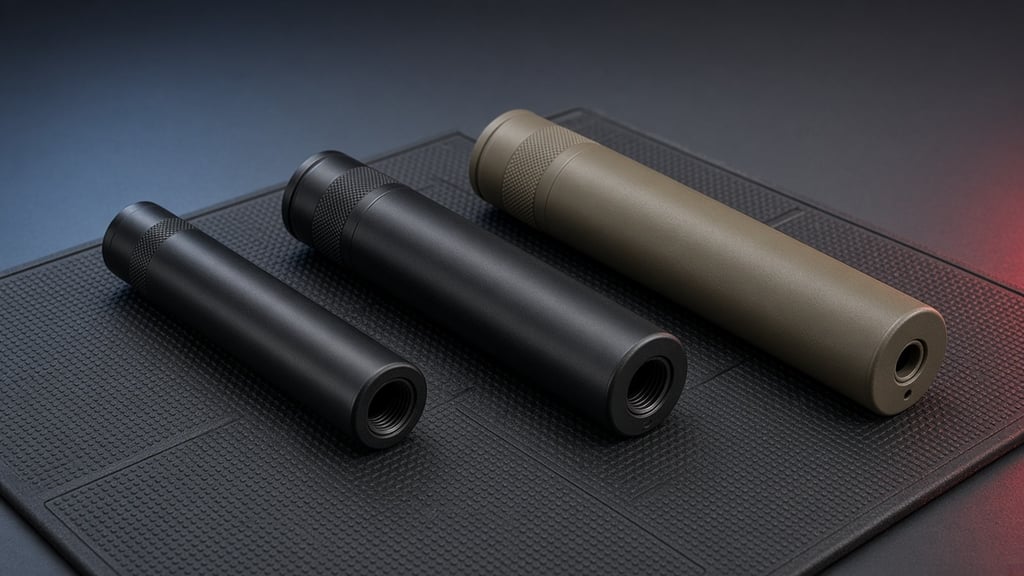
Picking your first suppressor is easier when you start with the gun you shoot most, not the can with the biggest spec sheet. This guide compares .22, 9mm and .30-caliber suppressors, covers mounts and thread pitch, and explains what buying one looks like in Nevada in 2026. It’s general information, not legal advice.
Start With the Gun You Shoot Most
A suppressor is built around a caliber rating and a mounting system. The right first can is the one that fits the firearm you’ll actually put rounds through every month. Ask yourself three questions before you shop:
- What do I shoot most? A .22 plinker, a 9mm pistol or carbine, or a centerfire rifle for hunting or the range.
- How is the barrel threaded? The can, or its mount, has to match your muzzle threads exactly.
- Is the host a pistol or a rifle? Most centerfire pistols need a booster to run a suppressor. Rifles and carbines don’t.
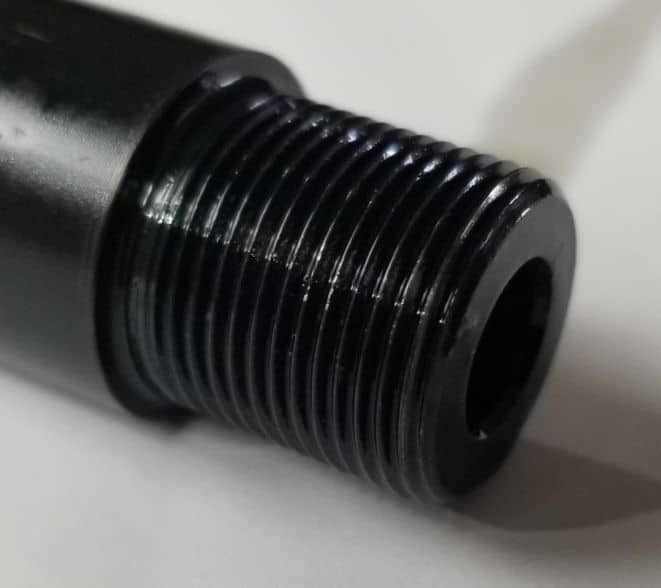
Check your threads against our Common Muzzle Threads reference. Keep in mind that an aftermarket or re-threaded barrel may not match the factory spec.
The .22 Suppressor: Cheap to Shoot, Easy to Learn On
A rimfire can is small and light, and .22 LR ammo is inexpensive, so it’s an easy way to learn how suppressed shooting works. On .22 LR, .22 Magnum and .17 HMR guns, 1/2×28 is the most common thread.
Rimfire ammo is dirty. Most .22 LR bullets have fully or partially exposed lead, and manufacturer manuals warn that suppressors collect carbon and lead residue. That’s why many rimfire cans come apart for cleaning, and why you should check before running .22 through a centerfire can. Dead Air, for example, tells owners of its Mojave 45 not to shoot .22 LR through it, because lead buildup can be hard or impossible to remove.
In stock example: the Rugged Mustang22 .22 LR suppressor (FDE, 1/2×28 direct thread). Rugged lists it at 3.3 ounces in its standard 5.3-inch configuration, with a shorter 3.4-inch option. It ships with a 1/2×28 direct-thread mount.
The 9mm Suppressor: Pistols, PCCs and Pistons
A 9mm can covers handguns and pistol-caliber carbines (PCCs). The most common 9mm thread is 1/2×28, but it isn’t universal. Glock and SIG barrels, for example, often use M13.5×1 left-hand threads, so match the piston or mount to your barrel.
Why pistols need a booster
Most centerfire handguns use a short-recoil, tilting-barrel action. The barrel and slide move back together briefly before they unlock. A suppressor’s extra weight on the muzzle can interrupt that movement and cause malfunctions. A booster (also called a piston or Nielsen device) uses a spring to let the barrel move while the suppressor briefly stays put, so the pistol cycles as designed.
Fixed-barrel guns, including most PCCs, don’t need the booster spring. They use a fixed spacer or a direct-thread mount instead.
In stock example: the Gemtech Lunar 9 modular 9mm pistol suppressor. Gemtech’s manual lists two lengths, 7 inches or 4.7 inches, and a 1/2×28 L.I.D. booster for locked-breech pistols. Fixed-barrel guns need a separate thread mount or Quickmount. Gemtech also rates it for subsonic 300 BLK on a fixed mount, with an 8-inch minimum barrel.
The .30-Cal Suppressor: One Can for Several Rifles
A .30-caliber rifle can is the most flexible choice if you own more than one centerfire rifle. Within its manufacturer rating, a .30 can can also be used on smaller bores such as 6.5 Creedmoor or 5.56. On .308-class rifles, 5/8×24 is the most common thread. Always confirm the rated calibers, any magnum limits and the minimum barrel lengths in the manual.
Two examples we have in stock show the range:
- Gemtech Tracker .30-cal aluminum direct-thread suppressor: Gemtech says it was designed for military snipers and adapted for hunters. It weighs 11.3 ounces, uses a 5/8×24 mount and is rated to .300 Win Mag.
- Dead Air RXD30Ti .30-cal titanium suppressor: Dead Air rates it for 6.5 Creedmoor and .308 Win up to .300 PRC, at 7.34 inches and 12.4 ounces, with minimum barrel lengths listed by caliber.
Quick Comparison
| .22 rimfire | 9mm | .30 caliber | |
|---|---|---|---|
| Best fit | Plinking, training, small game | Pistols and PCCs | Hunting and centerfire rifles |
| Most common thread | 1/2×28 | 1/2×28 (Glock and SIG often M13.5×1 LH) | 5/8×24 |
| Mounting note | Usually direct thread | Booster for tilting-barrel pistols | Direct thread or a quick-detach/HUB system |
| Cleaning | Frequent; rimfire is dirty | Depends on ammo and model | Follow the manual |
Supersonic vs. Subsonic Ammo
A suppressor reduces muzzle blast. It doesn’t slow the bullet down. If the bullet is supersonic, it still makes a sonic crack in flight, and the suppressor can’t remove that. Subsonic ammunition avoids the crack, but SilencerCo notes it is “not silent by any means.” Wear hearing protection and treat a suppressed firearm with the same care as any other.
Mounts: Direct Thread vs. Quick-Detach
- Direct thread: the can screws straight onto the barrel threads. It’s simple and usually the lightest setup, and a good fit for a dedicated host.
- Quick-detach or HUB-style systems: a muzzle device or adapter stays on each rifle, so moving one can between guns is faster. You’ll buy a mount for each host.
Whichever you pick, the mount must be fully seated on the barrel shoulder, and it’s worth checking that the can stays tight as you shoot.
Buying a Suppressor in Nevada in 2026
The federal tax on suppressors has been $0 since January 1, 2026. ATF’s October 9, 2026 guidance made federal Form 4 filing voluntary in some states, but Nevada buyers still need an approved ATF Form 4: NRS 202.350 allows a silencer only when it’s authorized by federal law. Our NFA Changes in 2026 article covers the details.
- Age: You must be 21 or older to buy any NFA item from 2A Guns.
- Paperwork: An approved Form 4, with fingerprints, a photo and registration.
- Fingerprints and photo: For local NFA purchases, we arrange them with a nearby partner shop, and that’s included in the transfer fee.
- Dealer-to-dealer: An ATF Form 3 is required for every dealer-to-dealer NFA transfer, in every state.
- Pickup: By appointment in Henderson, after the Form 4473 and background check.
State laws vary and federal policy could change, so check ATF, your state’s law or an attorney if you have a legal question.
Ready to Choose?
If you’re still deciding, start with the host you shoot most and work backward to the caliber rating and mount. Browse our suppressor inventory online, or schedule an appointment to see cans in person in Henderson. When it’s time for maintenance, see our suppressor cleaning service.
Questions? Call or text 702-566-5640 or schedule an appointment.
KEEP READING
More articles
Questions about this article?
Call or text 702-566-5640, or schedule an appointment — we’re happy to help.